Mortgage file workflow
Build a complete, submission-ready mortgage file, step by step
Start a file with the bare minimum, then follow a structured process to collect the information and documents required (income, debts, down payment, property, and so on). You can also invite the client to complete the forms through a secure link. On top of that, the AI can help you review the submitted data, spot what to improve and prepare the writing of the financing application.
Work with your client, votre lender and your team
in a structured file from the very first invitation.
The market problem
Mortgage files are often prepared through emails, scattered documents and manual follow-up. This workflow brings collection, verification and submission preparation into a single secure, traceable space.
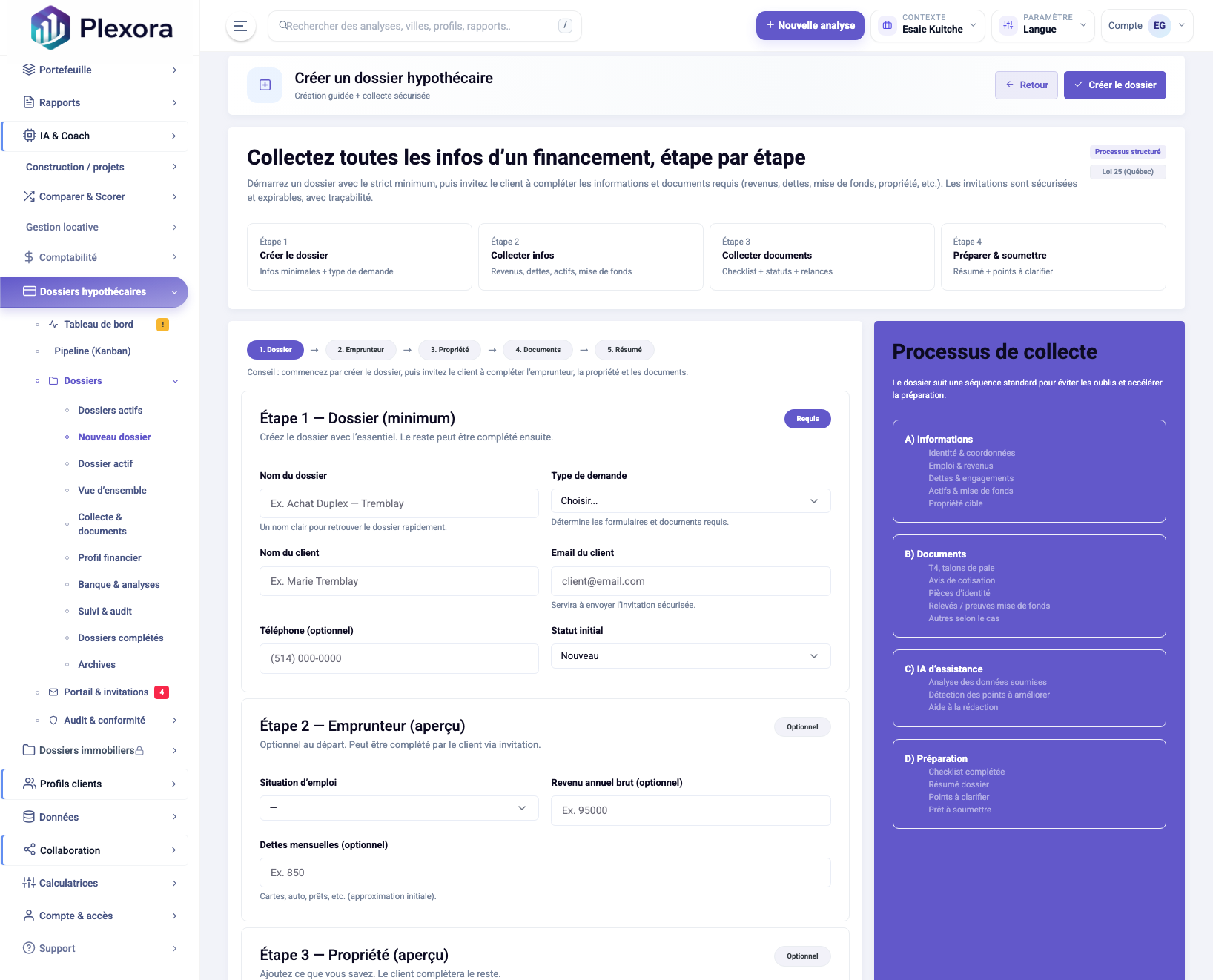
Step 1
Create the case
Minimum information + request type
Step 2
Collect information
Income, debts, assets, down payment
Step 3
Collect documents
Checklist + statuses + follow-ups
Step 4
Prepare & submit
File summary + points to clarify
The workflow at a glance
Invitation client
→
Document collection
→
Checklist complete
→
Analysis
→
Soumission
→
Audit & historique
This workflow structures collection, qualification and submission preparation before the file is even complete.
Enhanced security & Law 25 (Quebec)
Information and documents are collected in a secure environment with access controls, traceability and sound personal-information practices, to support operational compliance with Law 25.
This is not a generic CRM: it is a working process built to create, complete and defend a mortgage file.
1. Dossier
→
2. Emprunteur
→
3. Property
→
4. Documents
→
5. Summary
Tip: create the file first, then invite the client to complete the borrower/property/documents sections.
Collection process
The file follows a standard sequence, so nothing is forgotten and preparation moves faster. Data security is reinforced (access controls, traceability, sound practices), to support operational compliance with Law 25.
Secure client invitation
Client invited
→
forms completed
→
documents submitted
→
file ready for review
A) Informations
- Identity & contact details
- Employment & income
- Debts & commitments
- Assets & down payment
- Target property
B) Documents
- T4s, pay stubs
- Avis de cotisation
- Identity documents
- Statements / proof of down payment
- Others as applicable (land transfer, rental, etc.)
AI = assistance
- Analysis of the submitted data (summary, consistency, weak signals)
- Detection of what to improve before submission
- Help writing the application (draft, rationale, structure)
D) Preparation
- Checklist complete
- Case summary
- Critical points to validate
- Ready to submit
Best practices
Work with your client, your lender and your team in a single structured file. Use the invitation to cut down on email back-and-forth and keep a complete audit trail. The AI assists with preparation, without replacing professional judgment.
Privacy, Law 25 & use of AI
Information and documents are collected in a secure environment (access controls, traceability, logging) with practices aimed at operational compliance with Law 25 (Quebec). The AI assists with analysis and writing (summaries, spotting what to improve); it does not replace the broker’s professional judgment.